Portugal in miniature
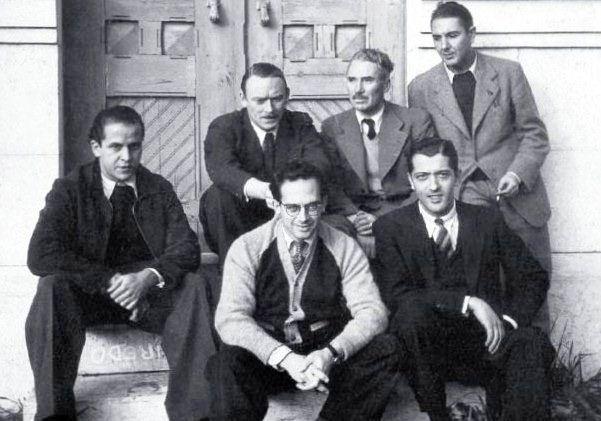
The figures were made to show Portugal to the world. In the late 1930s António Ferro's Secretariado de Propaganda Nacional (SPN) ran a campaign of cultural diplomacy and tourism promotion, the Estado Novo's Política do Espírito: a programme to idealise, stylise and promote the national identity, tourism and folklore of Portugal. Tom was one of its leading designers. With Carlos Botelho, Bernardo Marques and Fred Kradolfer he led the SPN's team of decorators, which built Portugal's pavilions at the great international exhibitions — Paris in 1937, where he won the prize for decoration and craftsmanship, and New York and San Francisco in 1939.
The wooden figures grew out of the same campaign. From 1939 the SPN sponsored Tom's first series of turned and painted regional types. Each figure stood for a region or a trade — the Lisbon washerwoman, the Ribatejo campino, the seaweed gatherers of Apúlia — and was sold with a printed leaflet in English, Wooden Figures by Tom, aimed squarely at visitors and buyers abroad.
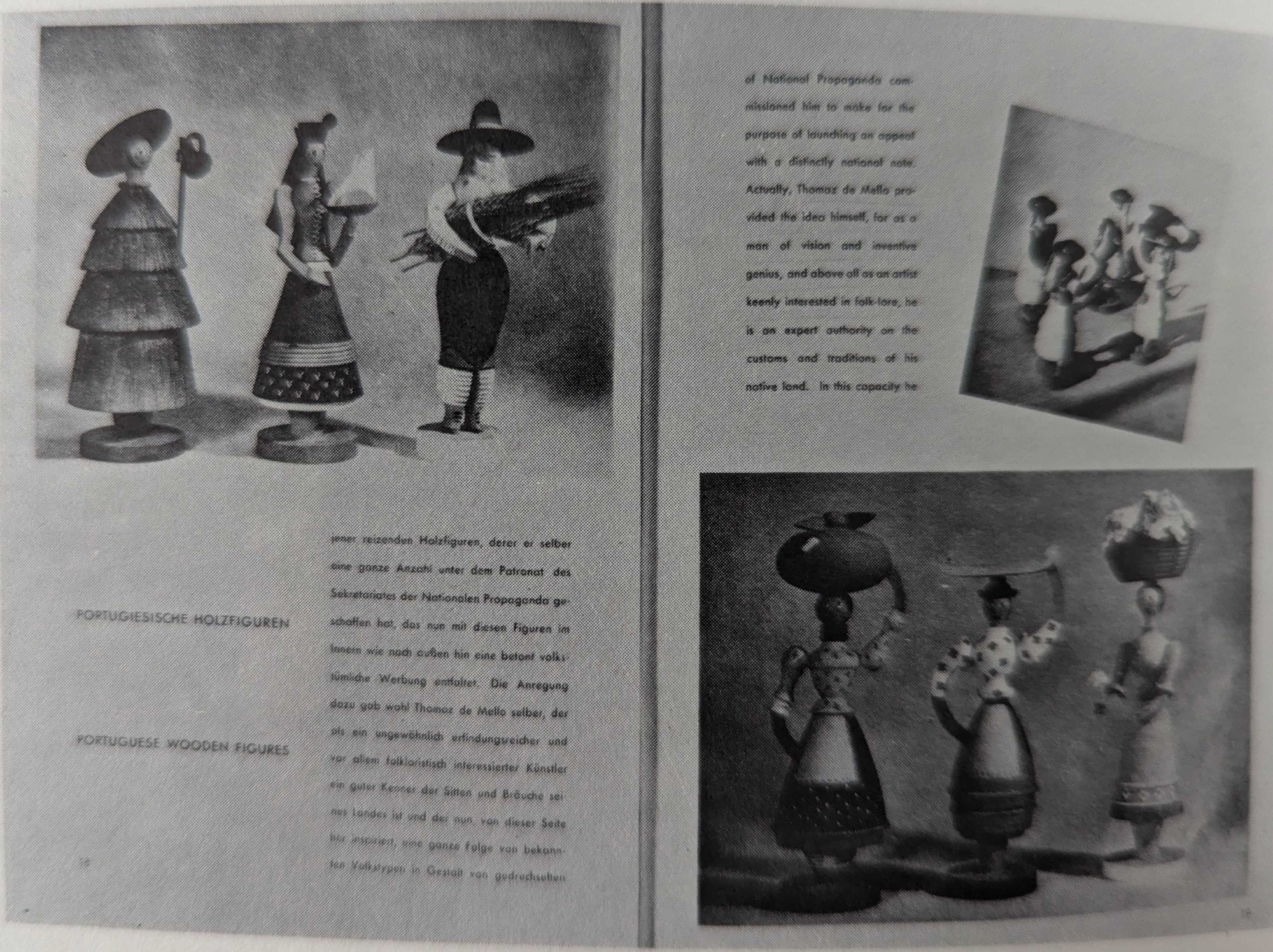
The message was carried abroad in print as well. A bilingual German and English feature, Portugiesische Holzfiguren / Portuguese Wooden Figures, presented the figures to foreign readers between 1936 and 1940: the Secretariat of National Propaganda, it explained, had "commissioned him to make them for the purpose of launching an appeal with a distinctly national note", promoting Portugal "at home and abroad" (im Innern wie nach außen hin). It credits the idea to Tom himself, "an artist keenly interested in folk-lore", and sees in the figures "a valuable national inheritance revived in the service of modern publicity".
They were on display in Lisbon in 1940, the year of the great Exposição do Mundo Português, and went on sale in the city's shops: one surviving washerwoman still carries the label of the Loja das Meias. Others travelled much further. A figure sold new by R.H. Stearns in Boston still has the department store's sticker on its base, and in 1949 the Lourenço Marques Guardian reported that Tom — by then artistic director of the "Feira Flutuante" sent to the colonies — had given the Lisbon firm Empresa Moderna the exclusive rights to sell his figures in Mozambique.
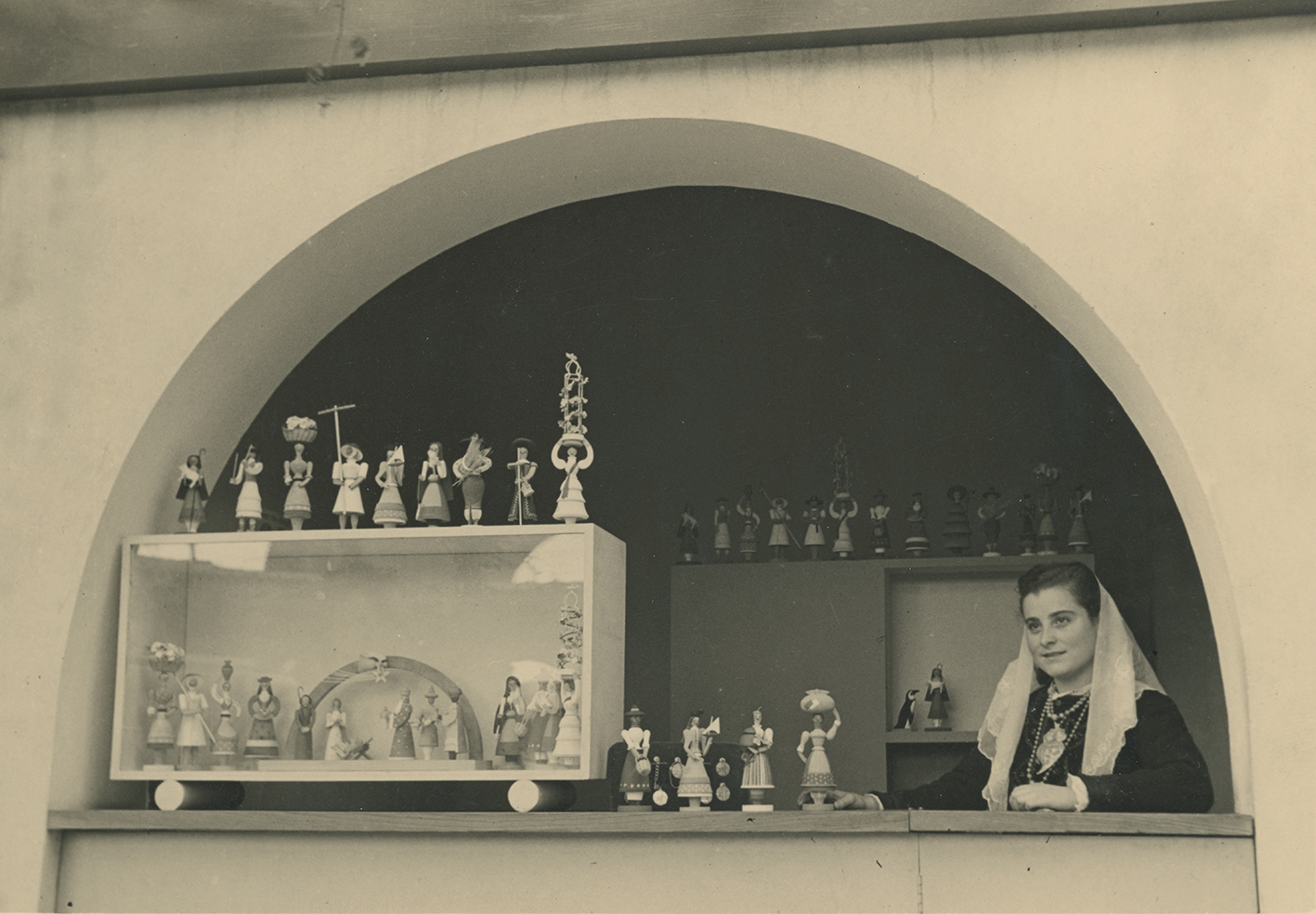
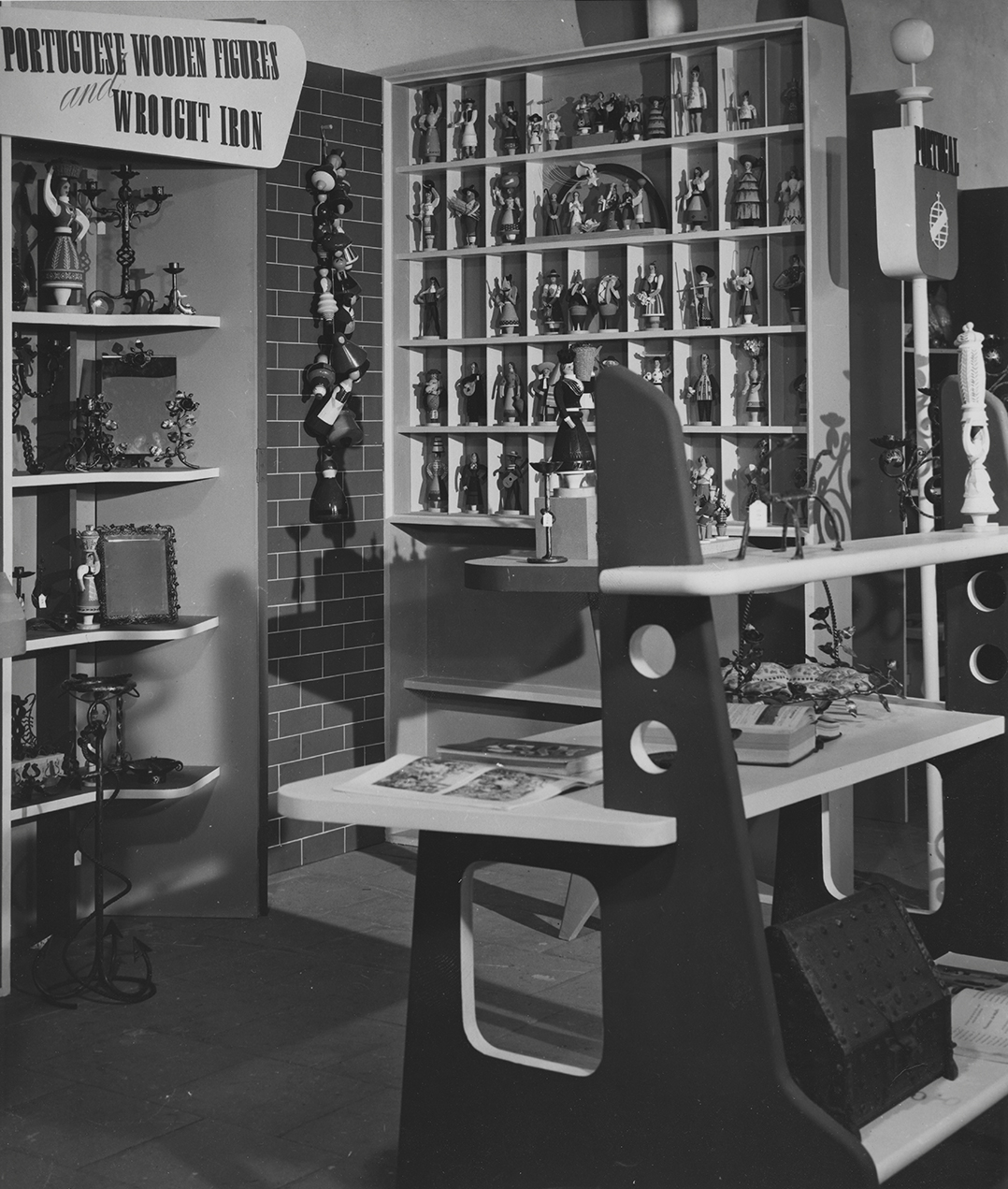
In 1950 they crossed the Atlantic as an export product in their own right, filling the shelves of a Portugal stand at a Chicago trade fair under the sign "Portuguese Wooden Figures", next to the country's wrought iron. Around 1970 Tom returned to the subject with a second series, the Bonecos Regionais Portugueses: twenty-five figures identified by province, in a flatter and more graphic style.
Made in Chiado
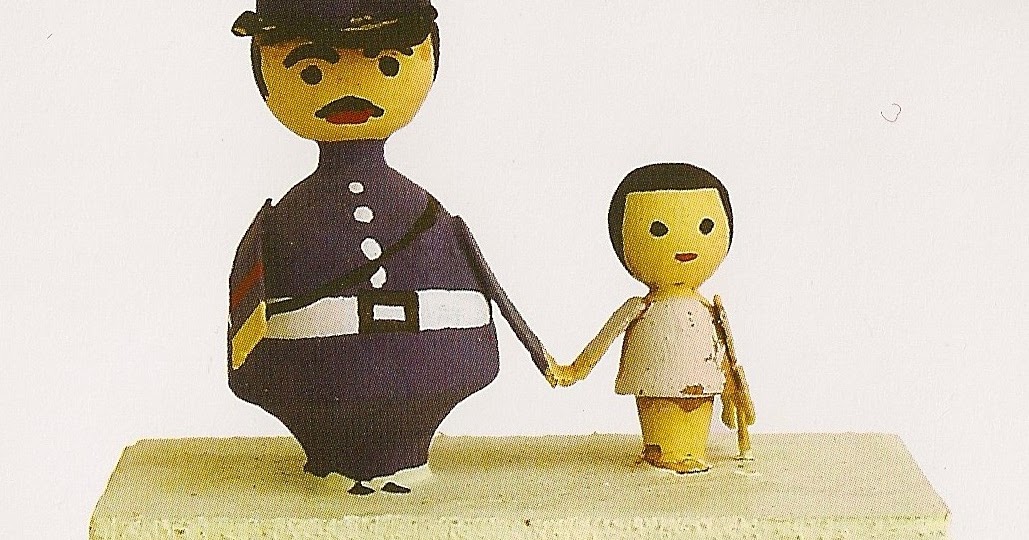
Before the regional figures came a set of experiments. From around 1935 Tom worked out a standard structure for the bodies and heads, which made the figures much easier to produce, and tried it on a series of tiny Miniaturas Portuguesas, about five centimetres tall and sold in screen-printed boxes. They are attributed to him on the strength of their drawing and modelling, and they look nothing like folklore: a cook, a policeman walking a child, a clown, a boxer, a fakir, a weightlifter, a skier, a samba dancer — city types, made with a good deal of humour.
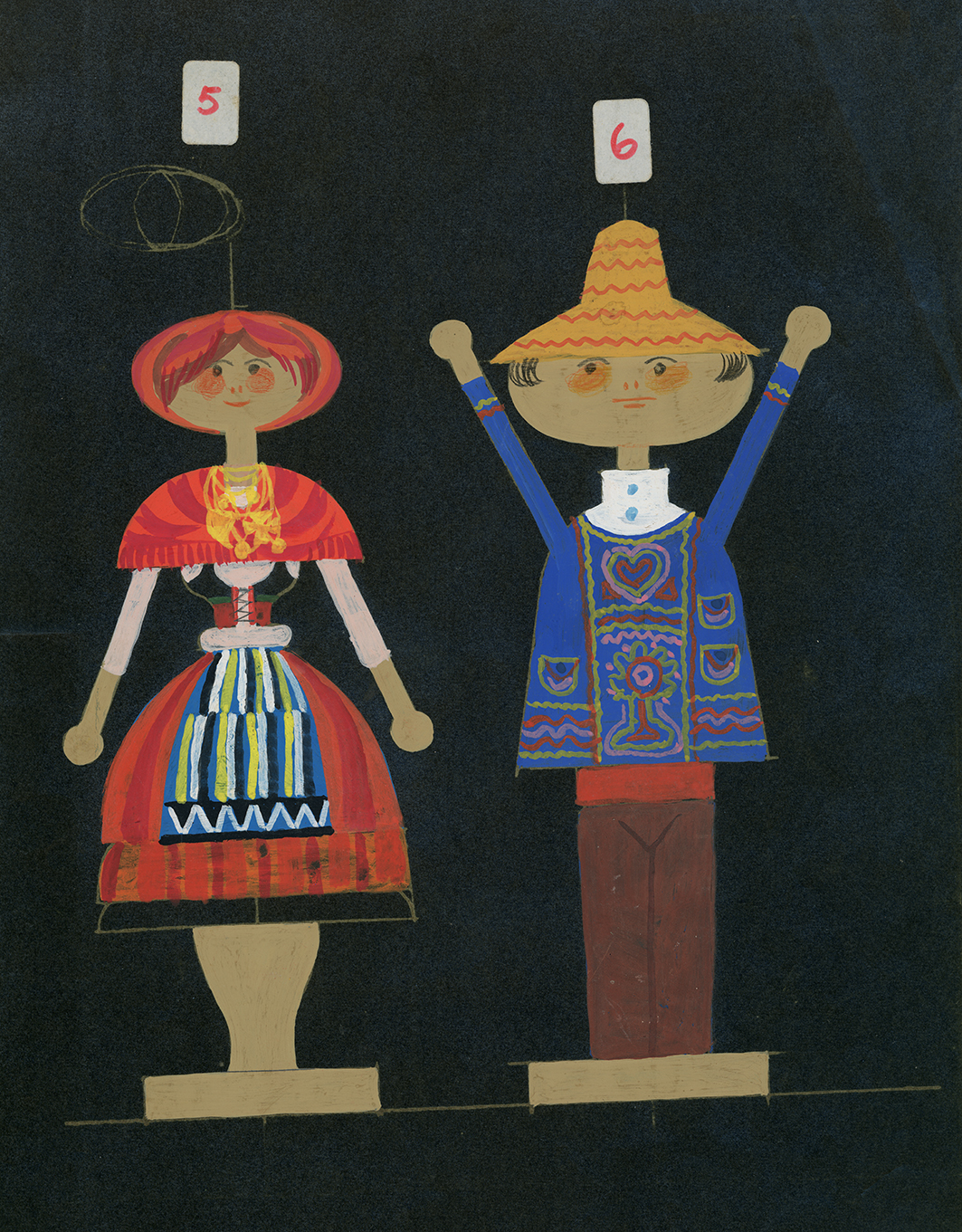
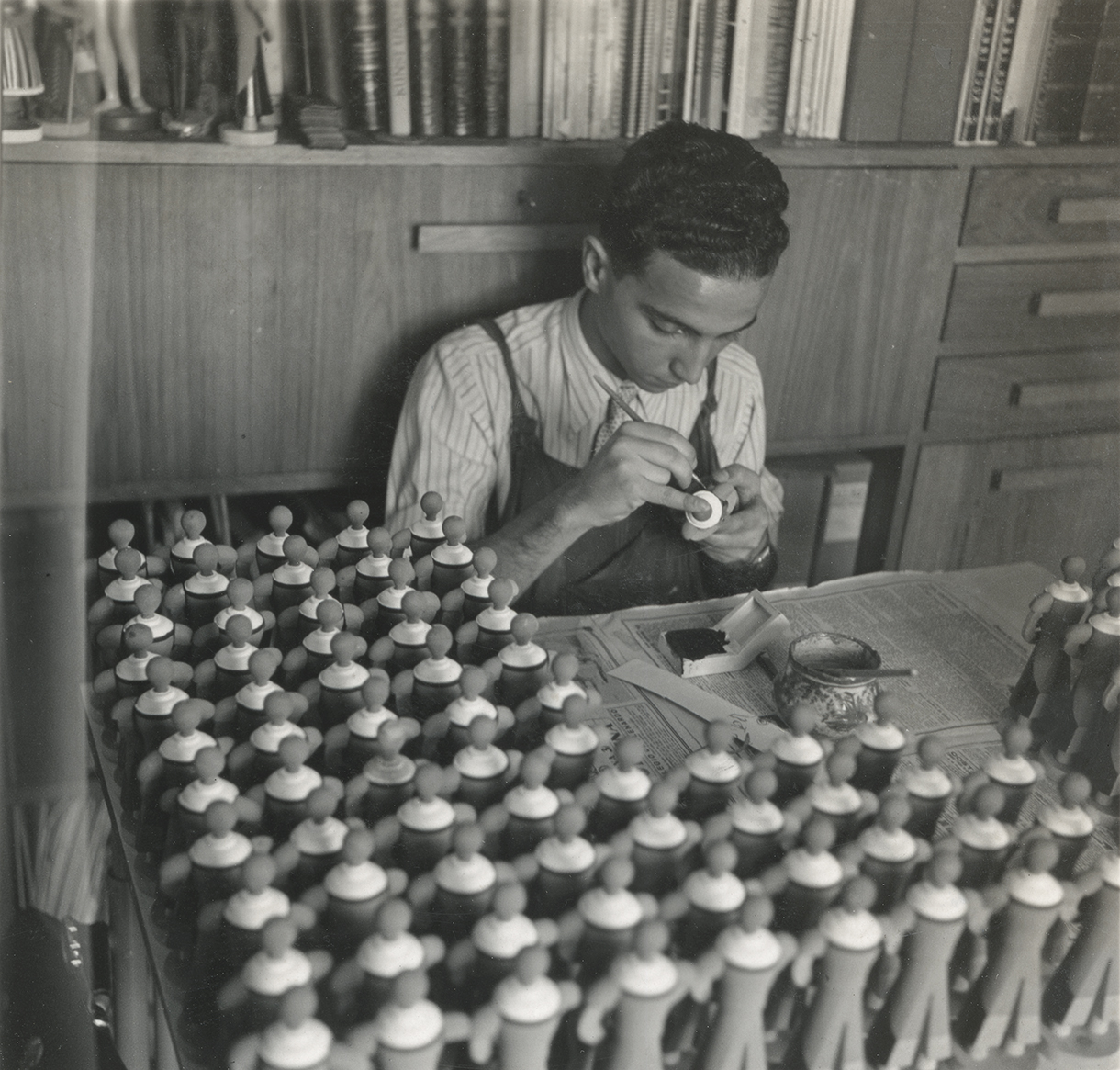
The regional figures were made in Tom's workshop in Chiado, at Rua Ivens 34 — the address printed on the first leaflet. The bodies were turned on the lathe from simple shapes, and the painting was done by students from the nearby Faculdade de Belas Artes. They worked from Tom's own painting models — gouache designs of each figure, numbered to match the leaflet — but with a good deal of freedom, so no two examples of a figure are quite alike: colours shift, motifs change, and the seaweed gatherer of Apúlia turns up both in a cap and in a broad-brimmed hat.
The first series was made in pine (pinho); the second in beech (faia) or pine. Many figures carry a stamp under the base — "Made in Portugal by Tom" or "Tom · Feito em Portugal" — often with the figure's number, which is how many of them can still be matched to their leaflet today. Beside the two series, the workshop also made pieces for clients such as the fado house Adega Machado and the fuel company SACOR; those are gathered on the Other page.
Further reading
Books
- Jorge Silva and José Bártolo, Tom: Ilustração e Design. Arranha Céus, 2020. The main monograph, published with the exhibition Os Bonecos de Tom at the Festa da Ilustração, Setúbal. Publisher
- Exposição Retrospectiva de 45 Anos na Obra de Thomaz de Mello – TOM. Secretariado Nacional de Informação, Palácio Foz, Lisbon, 1973. Exhibition catalogue covering 1928–1973, with an autobiographical text.
- José-Augusto França, A Arte em Portugal no Século XX. Bertrand, Lisbon, 1974.
Articles and exhibitions
- TOM — Todo o desenho possível, Casa do Design, Matosinhos, 2021: photo gallery in Público
- Jorge Silva, "Os Bonecos de Tom", a five-part series on the almanaque silva blog, 2020 — on the figures in part 5, "O Portugal dos Pequeninos"; all posts on Tom
- André Lopes Cardoso, "Miniaturas Portuguesas", Concept Board, 2013 — on the miniatures of the 1930s
- Thomaz de Mello (Tom), Centro de Arte Moderna, Fundação Calouste Gulbenkian
- Thomaz de Mello, Wikipedia (Portuguese)